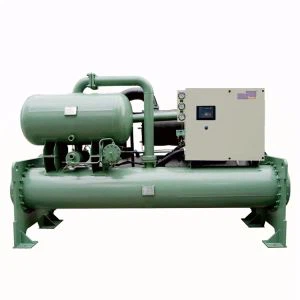
As a supplier of Screw Water Chillers, I often encounter inquiries from customers regarding the water flow rate requirements for these chillers. Understanding the appropriate water flow rate is crucial for the efficient and reliable operation of a screw water chiller. In this blog post, I will delve into the factors that influence the water flow rate requirement for a screw water chiller and provide some guidelines to help you determine the right flow rate for your specific application.
Factors Affecting Water Flow Rate Requirement
Cooling Capacity
The cooling capacity of a screw water chiller is one of the primary factors that determine the water flow rate requirement. The higher the cooling capacity, the more heat needs to be removed from the system, and thus a higher water flow rate is required. For example, a large - scale industrial screw water chiller with a high cooling capacity will need a greater volume of water to carry away the heat generated during the cooling process compared to a smaller chiller used in a commercial office setting.
Temperature Difference
The temperature difference between the inlet and outlet water of the chiller also plays a significant role. A larger temperature difference means that more heat is being transferred per unit volume of water. However, there are practical limits to the temperature difference. If the temperature difference is too large, it can lead to issues such as scaling, fouling, and reduced heat transfer efficiency. Generally, for most screw water chillers, a temperature difference of 5 - 10°C (9 - 18°F) between the inlet and outlet water is considered optimal.
Heat Transfer Efficiency
The design and construction of the chiller's heat exchanger impact the heat transfer efficiency. A more efficient heat exchanger can transfer heat more effectively with a lower water flow rate. Modern screw water chillers are often equipped with advanced heat exchanger designs, such as shell - and - tube or plate - type heat exchangers, which can enhance heat transfer and potentially reduce the required water flow rate.
System Configuration
The overall system configuration, including the presence of other components such as water pumps, water tanks, and piping, can affect the water flow rate. For instance, if the piping has a small diameter or there are many bends and fittings, it can create more resistance to the water flow, requiring a higher pump head and potentially a different water flow rate. Additionally, the type of water pump used in the system can influence the achievable water flow rate. Some pumps are designed for high - flow, low - pressure applications, while others are better suited for low - flow, high - pressure scenarios.
Calculating the Water Flow Rate
The water flow rate for a screw water chiller can be calculated using the following formula:
[Q=\frac{Q_{c}}{C_{p}\times\Delta T}]
Where:
- (Q) is the water flow rate (in m³/h or GPM - gallons per minute)
- (Q_{c}) is the cooling capacity of the chiller (in kW or BTU/h)
- (C_{p}) is the specific heat capacity of water ((C_{p}=4.186\ kJ/kg\cdot K) or (1\ BTU/lb\cdot°F))
- (\Delta T) is the temperature difference between the inlet and outlet water (in °C or °F)
Let's take an example. Suppose we have a screw water chiller with a cooling capacity of (100\ kW) and we want to maintain a temperature difference of (5°C) between the inlet and outlet water.
First, we need to convert the units. The specific heat capacity of water (C_{p} = 4.186\ kJ/kg\cdot K). Since (1\ kJ = 1000\ J) and (1\ kg) of water has a volume of (1\ liter) or (0.001\ m³).


We know that (Q_{c}=100\ kW = 100\ kJ/s)
[Q=\frac{Q_{c}}{C_{p}\times\Delta T}=\frac{100\ kJ/s}{4.186\ kJ/kg\cdot K\times5\ K}]
[Q=\frac{100}{4.186\times5}\ kg/s=\frac{100}{20.93}\ kg/s\approx4.78\ kg/s]
Since (1\ m³) of water has a mass of (1000\ kg), the flow rate in (m³/h) is:
[Q = 4.78\ kg/s\times\frac{3600\ s}{1\ h}\times\frac{1\ m³}{1000\ kg}\approx17.2\ m³/h]
Importance of Maintaining the Right Water Flow Rate
Maintaining the appropriate water flow rate is essential for several reasons. Firstly, it ensures efficient heat transfer. If the water flow rate is too low, the heat transfer efficiency will decrease, and the chiller may not be able to achieve the desired cooling capacity. This can lead to increased energy consumption as the chiller has to work harder to cool the process.
Secondly, a proper water flow rate helps prevent issues such as scaling and fouling. Insufficient water flow can cause the water to stagnate in the heat exchanger, allowing minerals and other contaminants to deposit on the heat transfer surfaces. Over time, this can reduce the heat transfer efficiency and may even damage the chiller.
On the other hand, if the water flow rate is too high, it can increase the energy consumption of the water pump and may also cause excessive wear and tear on the pump and other system components.
Products and Their Water Flow Rate Considerations
We offer a range of screw water chillers, including the Water Cooled Screw Chiller with Water Pump and Water Tank and the Water Cooled Heat Reclaim Chiller. Each of these products has its own specific water flow rate requirements based on their cooling capacity and design.
The Screw Water Chiller is designed to provide efficient cooling solutions for various applications. When selecting a chiller from our product line, our technical team can assist you in determining the appropriate water flow rate based on your specific needs. We take into account factors such as the size of the space to be cooled, the type of process being cooled, and the environmental conditions.
Conclusion
In conclusion, the water flow rate requirement for a screw water chiller is influenced by multiple factors, including cooling capacity, temperature difference, heat transfer efficiency, and system configuration. Calculating the right water flow rate is crucial for the efficient and reliable operation of the chiller. By maintaining the appropriate water flow rate, you can ensure optimal heat transfer, prevent scaling and fouling, and reduce energy consumption.
If you are in the market for a screw water chiller and need help determining the water flow rate requirements for your application, please do not hesitate to contact us. Our experienced team of experts is ready to assist you in selecting the right chiller and ensuring that it operates at its best. We are committed to providing high - quality products and excellent customer service. Whether you are a small business or a large industrial operation, we have the solution for your cooling needs.
References
- ASHRAE Handbook - HVAC Systems and Equipment. American Society of Heating, Refrigerating and Air - Conditioning Engineers.
- Chiller Design and Application Guide. Various industry publications and manufacturers' documentation.