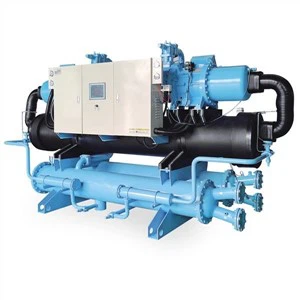
Alright, let's talk about a real workhorse in the industrial refrigeration and large HVAC world: the Flooded Shell and Tube Evaporator. You see these beasts in supermarkets, cold storage warehouses, big process cooling applications, and ice rinks – places demanding serious, reliable cooling power. But what makes them tick, and why choose one?
What Exactly Is It?
Picture this: a large cylindrical shell packed with a bundle of tubes. Here's the fundamental difference from the more common "dry" evaporator: Inside the shell, liquid refrigerant freely floods the space, completely surrounding the tube bundle. The fluid you actually want to chill – usually water, brine, or glycol – gets pumped through those tubes. Heat transfers from this process fluid, through the tube walls, into the refrigerant flooding the shell. This absorbed heat causes the refrigerant to boil and evaporate. The "flooded" name comes from that refrigerant literally flooding the shell side.

Why Do You Need This Design
Simple answer: Efficiency and Capacity at Scale. Dry evaporators (where refrigerant boils inside the tubes) struggle with efficiency in very large systems. They can suffer from uneven refrigerant distribution and poor wetting of the tube surface, especially under partial load. Flooded evaporators solve this brilliantly. By completely surrounding the tubes with liquid refrigerant, they ensure maximum contact area between the boiling refrigerant and the tube surface, all the time. This translates directly into significantly higher heat transfer efficiency compared to dry types, especially in large-tonnage applications. They handle large cooling loads far more effectively.
Key Features & Advantages
- Superior Heat Transfer: That full immersion is key. Boiling happens efficiently over the entire external surface area of the tube bundle. No dry spots, no wasted surface area.
- Handles Large Loads: This design scales beautifully. Need 500 tons of cooling? 1000 tons? Flooded evaporators are built for it.
- Advanced Tube Tech (The Secret Sauce): This is where modern flooded evaporators really leap ahead. The tubes themselves are engineering marvels:
- Enhanced External Surfaces: The outer surface (where boiling happens) often features special textures like porous layers or micro-fins (those "needle-shaped holes" you might hear about). This dramatically increases the surface area and provides countless nucleation sites for bubbles to form – making boiling far more vigorous and efficient.
- Enhanced Internal Surfaces: The inside of the tube (where water/brine flows) isn't forgotten. Spiral grooves or turbulators create turbulence, breaking up the boundary layer and significantly boosting the heat transfer from the process fluid to the tube wall.
- The Result: Combining these enhancements on both sides creates "high-efficiency heat transfer tubes." The impact is massive – we're talking heat transfer coefficients potentially 4 to 5 times higher than a plain, smooth "light tube." This directly means a smaller, more compact evaporator can handle the same load, or a similarly sized unit delivers much more cooling.
The Bottom Line
That flooded refrigerant bath, combined with sophisticated enhanced tube technology, delivers unbeatable heat transfer performance. While they might have a higher initial cost and require more refrigerant charge than dry types, their superior efficiency and robustness in big systems make them a very smart, cost-effective investment over the long haul. They're the quiet, powerful backbone keeping massive cooling operations running smoothly.